Tim Mahon
In March 2025 Havelsan and Kader Factory for Developed Industries (part of the Arab Organisation for Industrialisation – AOI) announced a strategic collaboration under which the two entities would work towards joint production of UGVs (uncrewed ground vehicles) in Egypt, licensing Havelsan’s design language and technologies with additional technical and manufacturing support from the Turkish company. It was stressed at the time that the result would not simply be an indigenous copy of Havelsan’s Barkan UGV but would be a genuine Turkish-Egyptian platform – one that would be ready for public display by the opening of the EDEX exhibition in September that year. The deal was framed at the time – and since – as a technology transfer and strategic partnership aimed at strengthening the defence capabilities of both nations.
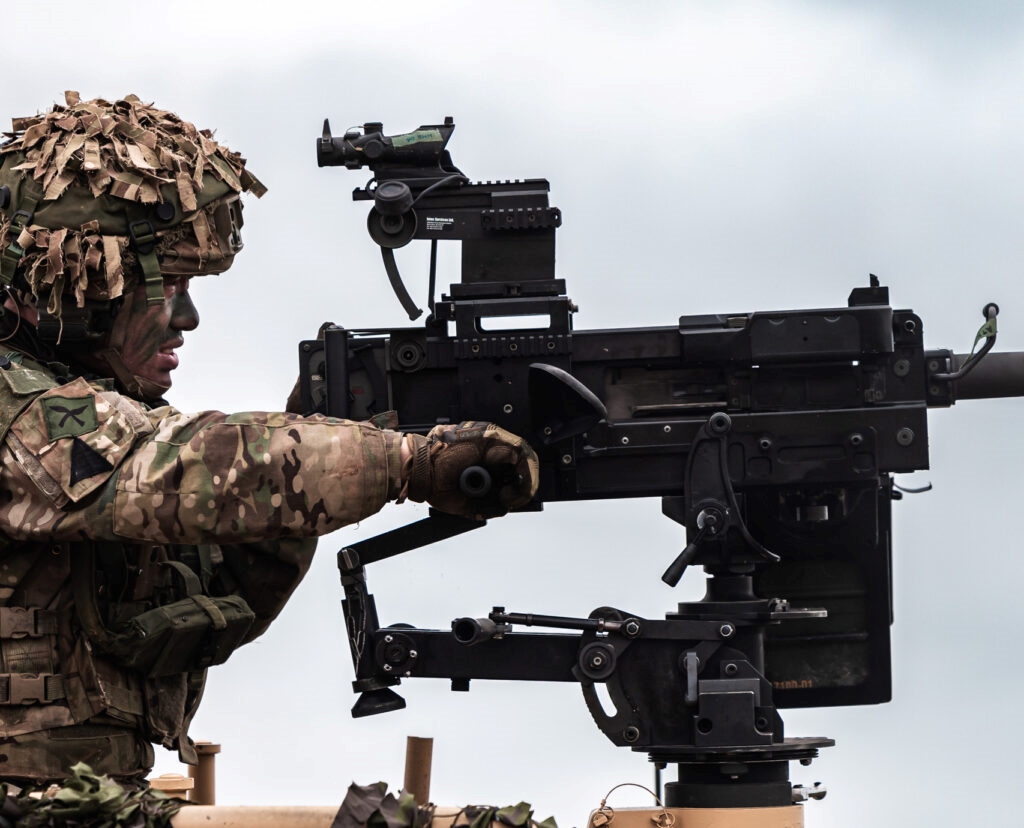
Although details are sketchy, at least some of that ambition appears to have been realised. Sources close to both parties told Defence Alternatives recently that at least one UGV that appeared at EDEX 2025 seems to have its origins in the collaboration as a derivative of a Havelsan design. This was the Agrab, displayed on the AOI stand as a “co-developed UGV,” described as visually similar to Havelsan’s Kapgan platform but smaller (6×6 rather than 8×8) and fitted with a Trakon Lite RWS and a .50 col machine-gun. Company representatives suggested the Agrab would be jointly produced to fulfil any orders placed.
It is far too early to make any firm predictions regarding Egypt’s UGV procurement trajectory – but it does seem clear that Cairo is positioning itself to become a regional hub for autonomous ground systems, including a range of unattended ground sensors, according to at least one knowledgeable source. The transition from proof of concept to prototype to procurement and series production is accelerating but not yet mature.
On the road to maturity stands the Anubis platform, unveiled by AOI in November last year and specifically framed by the organisation as being an important component of a broader and comprehensive autonomy strategy. Egypt’s most mature UGV to date, Anubis – named for the ancient god of funerary rites, mummification and the afterlife – is a combat UGV features a modular turret capable of mounting 7.62 or 12.7mm machineguns, automated grenade launchers or anti-tank guided weapons.
Foreign partners are an essential requirement for Egypt’s nascent autonomous systems industry and Havelsan is currently dominating the scene industrially. However, China is a traditional supplier and partner to Egypt’s military industries and Norinco, among other state-owned firms, is pushing hard for Cairo to diversify sources of supply – for technology and knowledge transfer, apparently, as well as direct foreign sales. However, it is fair to say that the current mix of Turkish autonomy software and Egyptian manufacturing capacity is the biggest driver shaping the nation’s emerging UGV family. Egypt’s defence industrial strategy heavily favours co-production and technology transfer, so the emergence of a UGV entirely tailored to Egyptian requirements is to be anticipated.
So what happens next? Speaking with several sources close to one or both organisations, Defence Alternatives suggests the following likely pathway to Egypt fielding UGVs at scale. In the immediate future (2026-2027), field trials for both Agrab and Anubis, testing of modular payloads and weapon systems and the integration of Havelsan autonomy packages. In the medium term (2028-2029) limited procurement of quantities for more extensive testing and to facilitate doctrinal development. This may well include procurement of specialised variants for border security and counter-insurgency forces, as well as ‘battlefield’ variants for use within small infantry units.
From 2030 and beyond a more comprehensive strategy is likely, embracing a family of UGVs across a wide range of weight and capability classes, aimed at fulfilling operational requirements for Egypt’s armed forces and a market – assessed by some industrial strategists as significant – throughout Africa and the Middle East that will be maturing in the same timeframe.
Egypt is clearly pursuing a twin-track strategy for ground-based autonomous systems: co-production, fueled by rapid technology injection, as exemplified by Agrab; and the development of longer-term sovereign capability, designed to anchor the future UGV fleet, for which Anubis is the harbinger. Nothing less than full spectrum capability will suffice!
Headline image, generated by AI for Defence Alternatives, shows a potential future representation of Egypt’s emerging UGV ecosystem in both combat and border security applications