Andrew Marszewski – Correspondent at Large
In the reality of modern warfare, anti-personnel and anti-tank mines have always been the soldier’s greatest danger and the commander’s nightmare. They are highly effective capabilities for pinning down armoured forces, being cheap to lay, deadly to encounter and challenging for an offensive force to clear under fire. Front line footage from Ukraine shows what happens next: mines are scattered widely across the vehicle’s intended route; then the column is forced to stop where it is exposed to the mercy of artillery which, put simply, does the rest.
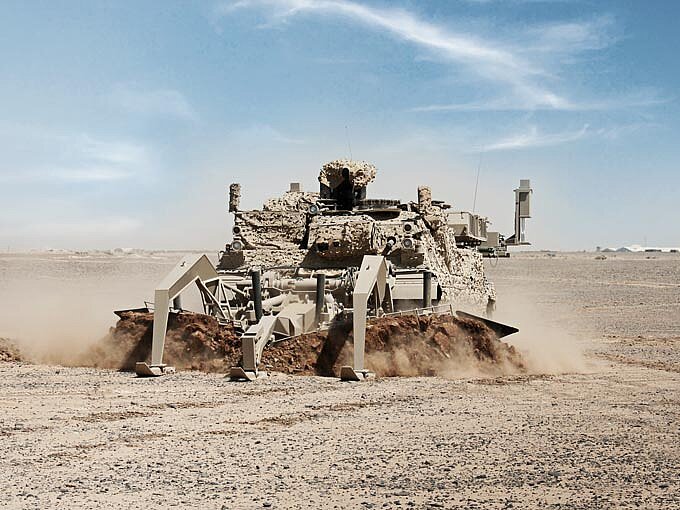
These early lessons from the Donbas were observed attentively by a Newcastle-based battlefield mobility firm, Pearson Engineering, which saw them and got straight down to work. They came up with the Threat-Sense solution, an AI-powered detection system that uses deep learning algorithms to identify surface-laid anti-tank and anti-personnel mines in real time, from any camera-equipped military vehicle or drone.
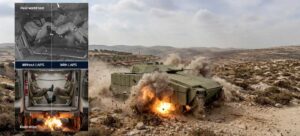
The system is built around a fully passive Threat-Sense Processing Unit that analyses live video feeds, including from a vehicle’s existing camera suite, against a comprehensive, user-expandable threat library. The system detects a mine, then flags it on the crew’s display, giving both an audible warning and a threat confidence rating. The key lies in its simplicity and passive operation, with no radiated emissions, minimal installation and its ability to deploy in all battlefield conditions such as rain, smoke and mist – the literal fog of war.
What separates Threat-Sense from a clever piece of software is that it has been tested in real world conditions and not just on a range. It has been trialled with NATO allies at Suffield in Canada, demonstrated to over 30 delegations at the Combat Engineering Exhibition at Larkhill in 2024 and has been integrated on platforms ranging from the Foxhound PPV to the Patria AMV 8×8. Following extensive user feedback and collaboration with international science and technology organisations, the capability was extended to UAVs. In October 2025, Pearson, collaborating with US drone manufacturer Skydio, integrated Threat-Sense into their NATO-approved X10D drone platform. This has given ground forces the ability to map threats from a 5km range and to feed GPS-tagged data directly into ATAK and battlefield management systems.
The human dimension matters here too. Threat-Sense is deliberately designed to support the commander’s decision, not replace it. In a defence culture increasingly anxious about autonomous systems and the removal of meaningful human control, that design choice is as important as any technical specification.
Pearson Engineering announced that it will showcase its latest demining and threat-reduction technologies at Eurosatory 2026, highlighting how robotics and automation can address the growing global challenge of landmine contamination. Visitors will be able to trial both the new MineWolf MW370 Next Generation unmanned high-capacity clearance vehicle and see the Threat-Sense system first hand. Building on more than 40 years of expertise in military mobility and minefield breaching, Pearson Engineering argues that combining these systems can improve demining productivity, enhance operator safety and support both military and humanitarian clearance operations by reducing risk and removing personnel from harm’s way.
It is very clear that the mine clearence problem is not going away anytime soon. The technology to address it however, at least in part, already exists and is British made. The question procurement authorities will need to answer is whether they can move at the speed the threat demands.
Headline image shows an operator viewing Threat-Sense output. (Pearson Engineering)