Jonas Johnson is Director of Business Development for Army and SOCOM at New York-based Persistent Systems, where he has spent much of the last four years working on the MCHMR product line. No – not named after the rap artist but an acronym for the Mobile Ad Hoc Network–Cloud High Mobility Radio, recently fielded by US forces in Morocco during the African Lion 2026 multinational exercise. He recently briefed Defence Alternatives on what Persistent does and how MCHMR makes a difference.
Defence Alternatives: Help me understand what MCHMR is, what sets it apart and why it is generating so much interest with the USAF and other potential operators.
Jonas Johnson: OK – so Persistent Systems is a networking company: we don’t do anything special or different with our transmission. We’re a network company – that’s just how we communicate. What makes us different is Wave Relay – that’s our algorithm that communicates and passes through the ones and zeros at the end of the day. So – as a networking company, we have created a product line that communicates via RF – what we call Layer 2, so that’s always going to be line of sight. But we also have this connectivity capability, so these RF comms bubble up into the masses or the Internet right at Layer 3.
Fast forward now to 2023 when MCHMR was created by the US Air Force. They saw a huge problem with the volume of data at the tactical edge – masses of it but only actionable within a finite amount of time: some data is more sensitive and has a shorter lifespan. The relevant data wasn’t getting through in anything like real time, so they envisioned a platform design that brought all these data types and message formats into one location. That location can then share that data based on sensitivity or access requests.
MCHMR is our mobile ad hoc networking cloud, high-mobility radio system – a capability that arrives in a roll-on, roll-off hard case with a Dell XR4000 server to conduct all the compute operations. In addition, there are two of our MPU5s built in. What this does is to take in all that tactical data, bring it in via line of sight and route it up through the cloud for processing. Security is dealt with by marking data packages to be routed to sensitive or even up to secret level areas or to remain on the unclassified side.
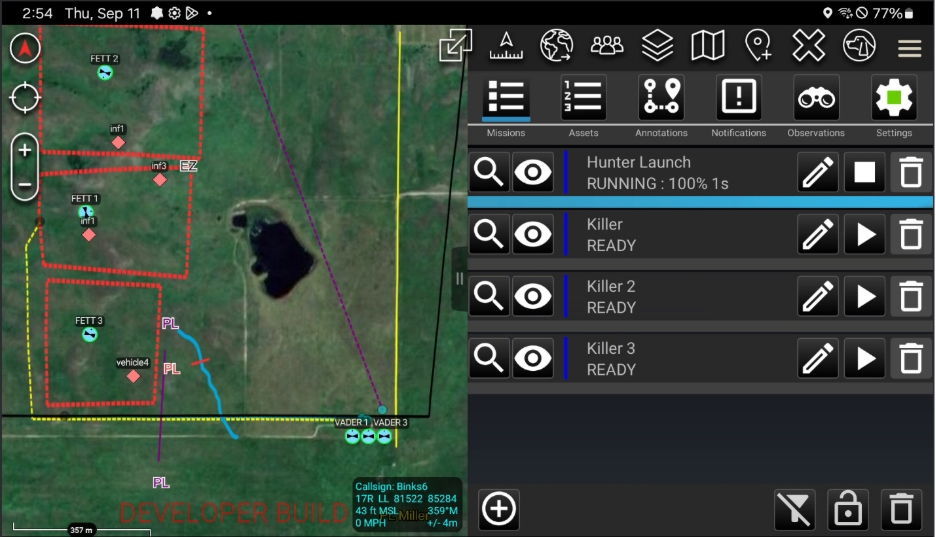
Bringing that into the perspective of the exercise African Lion that we supported, we had Moroccan troops being introduced to the concept of open access to a vast amount of unclassified data. This could be voice traffic, position/location info, full motion video, raw data or even the ability to control an unmanned ground or aerial vehicle from the location. All this with data from a wide variety of sources and available to the user in a very compact form factor with a huge capacity for cloud networking. From a US DoW perspective you’re talking thousands of sensors from across the battle space, from full motion video in strike mode to alert warning systems to enable counter-UAS engagement.
That’s what Wave Relay does. All that data now comes into MCHMR, which does the AI and machine learning processing, informing the user where the data should go and who should have access to it. It’s a really interesting concept and what we have seen in previous exercises is how much attention this capability has garnered. Everyone is starting to see the capability, understand the use cases and start to think about how to exploit it. That, I would say, is where the serious interest we have seen recently from the Army and Marine Corps has come from.
DA: So this is the next evolution of Wave Relay? Or is it?
JJ: What this is doing is expanding on Wave Relay technology to get to these discrete capabilities. Without Wave Relay you simply have very nuanced communication sets that can’t talk to a central repository, with all that data still out there just blowing around seamlessly, not getting to where it needs to go.
DA: So MCHMR provides the same interconnectivity, interoperability and common operating environment and it really doesn’t matter whether you’re Moroccan, speaking French or an American speaking Texan. Is that a fair summation?
JJ: You’re correct. It’s one of many factors in our ecosystem and, together with additional companies like Dell, Sierra Nevada and Trax, it’s all part of what makes MCHMR a capability. Partnering with companies like this means that UAS operators, for example, can pitch up with their equipment and they know that MCHMR is going to be able to provide that RF network – and the connection to the cloud.
DA: Supporting these exercises – which you have done a lot of in the last several years – is that under contract or is it part of your broader marketing?
JJ: Great question. Since we’ve rolled out MCHMR, this has all been under contract with the Air Force. Even in African Lion, the Air Force was excited about having MCHMR there and so contracted the man hours and support. And when players brought their own equipment in – that’s when the Army’s eyes really opened up. That sold the power of MCHMR .
DA: There appears to be a real groundswell of excitement here, so what is the next step for you? How do you see yourselves capitalising on this – and when?
JJ: Well, we’ve recently been added to the configuration control board run by the Air Force and we are working closely with the US Army liaison officer there to refine Army requirements, then we have a series of exercises in North Carolina and Germany. Frankly, I see the Army adopting this quickly and in significant volume – we already have conversations about potentially supporting requirements for deployable operational units, for example. And just as an aside – Morocco is building a training environment which will integrate Wave Relay from the get go, just so they can provide their own and allied troops with that extended RF network.
DA: Have you seen any particular challenges or cultural issues in having, say, Moroccan and US troops working this solution together?
JJ: Another great question. As of now, we have not had any issues when it comes to federating those host nations to that data pool or then sharing that information in that data pool. That’s one of the beauties of MCHMR. It’s broken into multiple enclaves and when we designate the enclave and add full autonomy to it, we have real time information. But we can cater for all levels of security – Five Eyes partners only, for example or, if designated secret by DoW – Impact Layer 6 – then it’s US Eyes Only. That’s what really makes it so easy to integrate host nation partners like Moroccan or Korean forces – it’s just a matter of a couple of IP address changes and then connections via either a 5G Starlink or internet.
DA: Impressive. So how are you going to stay ahead?
JJ: I think we have to continue to do two things that we have always done right. We have to listen to the customer and the requirements and then we have to be present. Those two things combined, I believe that’s going to help us continue to change and adapt what we do, whether it’s our waveform or how we produce it in our product line.
DA: Finally, can you say anything about how much has been spent on this to date – ballpark figures?
JJ: Up to this point, in the roughly two years the programme’s been going, we’re just past the $30 million mark with the Air Force. Now when we look at fielding throughout the army, that’s going to become exponentially bigger when you start to look at division-sized units. I would say that could easily exceed the $100 million mark if this does become a programme of record and the Army fully employs this. And on top of that, when you consider additional sales with other host nations as well – I think we are going to see a lot of acceleration there too.
DA: All in all it sounds like interesting times ahead. Thanks for the insight, Jonas – and we will be keeping an eye on MCHMR progress in the coming months.
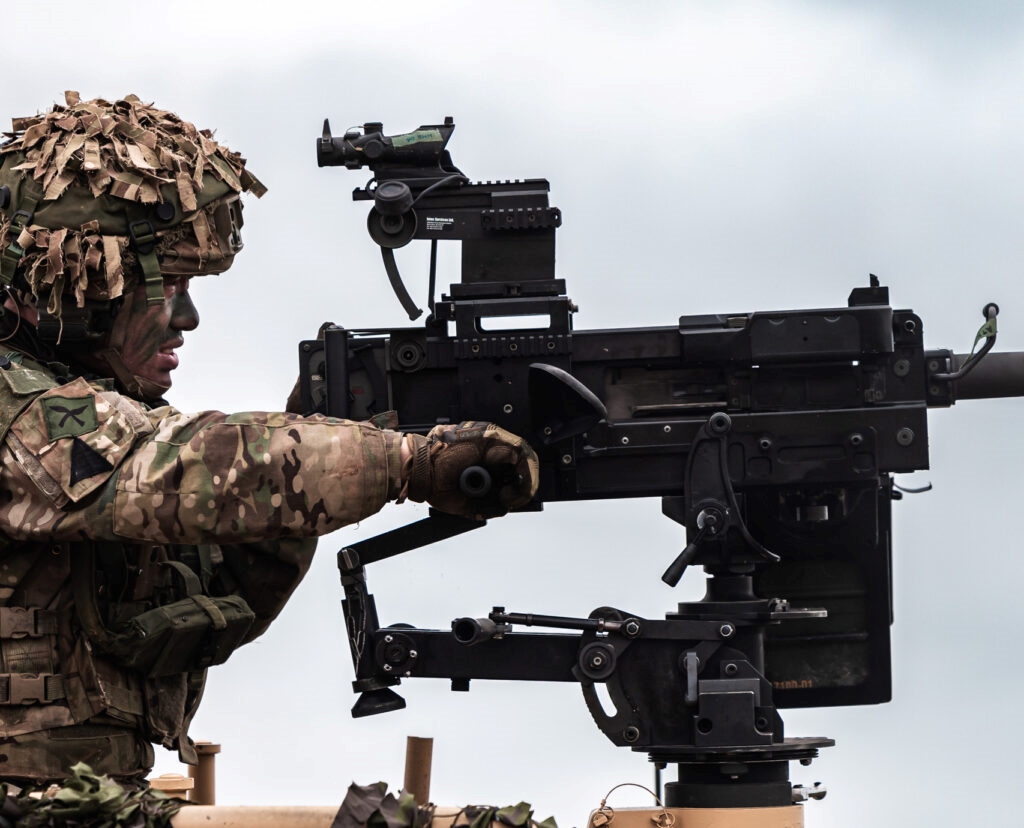
Headline image shows Persistent’s MPU5s – a critical component of the MCHMR capability – in use with US and Moroccan forces during African Lion 2026. (Persistent Systems)