At IAV in Farnborough in January, Forterra gave a presentation focused on the use of autonomy in combat. Although Defence Alternatives was unable to attend that session, the company’s VP for Defense Growth, Pat Acox, kindly answered Tim Mahon’s questions in a remote interview in February. The result – an engaging, experience-based exposé of just some of the intertwined complexities confronting those developing the capabilities and the operational disciplines surrounding autonomous combat. A long read – but worth the journey…
Defence Alternatives: From your perspective, what vulnerabilities in combat have you seen in Ukraine – or anywhere else you’ve been studying? Throughout, I’m talking about UxS so it’s not just ground, but air and maritime also.
Pat Acox: I really appreciate the question. And if you don’t mind, maybe we’ll go on a little bit of a walk down memory lane. UGVs have been in existence for decades: I think the Russians had the first tele-operated tank factor back in World War Two. The same applies to uncrewed aircraft: look at the Skunk Works and how they were taking photos and popping back out in the 70s; uncrewed, unmanned, uninhabited platforms, whatever term has been used, have a solid foundation. The vulnerabilities for deployment, I think, boil down to just one – adoption. I think the biggest risk is adoption and the manner in which people interact or use the tools at hand.
That’s a little bit of a sideways way to come at the answer, but if we go back to the MQ-1 and MQ-9 – what I’ll call the ‘big UAS’, they were neat when they flew; they became really interesting when you put sensors on them; then became really, really interesting when they enabled strike operations. That was about 20 years of learning – in a conflict – to say ‘how do I project force in a way that allows us persistence, capability and remote ops?’ I think that, on the ground side, one of the big issues is it’s a lot harder to drive things around in a pretty congested, constrained environment. Operating in 3d airspace or in a maritime environment you have choices – open-ended areas just don’t run into ground, or don’t hit another ship – but on the ground mobility and trafficability all of a sudden become key concerns. Some vehicles can go through pretty dense vegetation: ‘I have a tank, I can knock over small trees.’ But in a buggy of some kind, that tree becomes a blown radiator.
So the first vulnerability, I would say, is the environment: how does tall grass affect my progress. In fact, such areas are becoming more and more of a solved problem. But how do I now work in a more detailed environment? It’s no longer an issue of air supremacy, where you can act more or less with impunity – you’re just not worried about A2AD. Whereas on the ground side inherently come relatively close to other actors, neutral, friendly or adversarial. How do you navigate that aspect? So, it’s just more complex.
As far as central limitations are concerned, you get into the question of passive versus active sensors and what that means for the age old mousetrap, which suddenly has a unique sensor. I can find it. Using a mine roller example, The US had an $800,000 mine roller to basically overcome an $80 mine: call that a cost juxtaposition or a cost dichotomy – that’s one side of the issue. On the other is dependence on reliable communications – an interesting issue, because autonomous systems inherently don’t really need reliable comms, they simply need to be able to complete tasks. The vulnerability here, in fact, may be human interaction, because it boils down to ‘how much do I trust that this thing is going to go do what I say?’ Trust, but verify.
And just like comms dynamics are challenging, I don’t have clear lines of sight like UAS do in the big blue sky. I have to overcome the curvature of the Earth – and that’s before you even consider the issue of scale. I think it’s a lot more difficult to scale assets on the ground. If I fly a 20lb aircraft around it may fall out of the sky and could hurt somebody but, relatively, it’s not that big a deal. The implications of something going wrong moving a 40,000lb vehicle around are sort of different.
So, vulnerabilities, right? How do the uncrewed platforms perceive the world? How are they sensed in that operating environment? And how do people interact. I think these are really the driving factors, but it’s a clear enough story of the problems that need to be overcome. Now we’re really debating around the periphery – how to get scale, for example. Sorry, a little bit of a walk, but hopefully that’s a good scene set for what we’re going to get to.
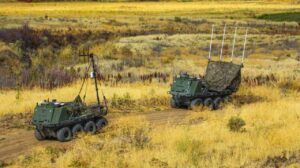
DA: Not a problem – cogently expressed and thanks for that. Looking at UGVs specifically, how dependent are we on a reliable, robust HMI? How can it be disrupted and how can we prevent that disruption?
PA: I’ll anchor back to the usability perspective. In a sense, you boil down to tasking: I want to be able to task assets that appropriate for my position. A brigade commander wanting to get through to a squad has to work through the chain of command through various radio links, messengers or couriers – anything along those lines. The issue of robust HMI is a great question from the perspective of at what level and how far down you want to reach: that’s really for oversight situational awareness and for when you get into tasking of systems.
So think about the mobility piece, which is intriguing. If something goes from point A to point B, it’s interesting if it’s for logistics, right? I care about this thing that went from point A to point B with a mission in mind. But as soon as you start talking about weaponizing it you have the question ‘am I maintaining custody of said weapon system?’ What other actors are present as I as I transit? I don’t want emissions to betray my position, just as I don’t want a bright flashlight while conducting night operations. It’s an important issue, from a trust perspective, that I trust it’s going to get to its location then, when it arrives, I trust that my comms to facilitate execution of that mission.
As for disruption – we are not relying on an individual here to say ‘go from point one to point two to point three and execute actions on target X at point four.’ I just drop the mission package and say ‘get to point four, execute then report back.’ Meanwhile, we’re watching with Gen AI and some of the other technologies coming into the frame now, all the while thinking on ‘how do I translate what would otherwise be a pretty lengthy mission decomposition, really send an intention across and trust the robot’s going to execute on the ground in a safe, reliable, dependable way?
DA: It strikes me that when commanders, particularly Junior commanders at a tactical level, are offered this level of capability, the temptation may very well be to say, ‘Wow, this can do everything: this is a one stop shop for tactical dominance.’ You and I both know that ain’t true. So I’ve chosen four mission areas: ISR, fires, supply and medevac. Can you give us succinct pros and cons, advantages and disadvantages of UGVs for each of those areas?
PA: I can give a pretty quick rundown. So, ISR – right in the so-called Global War on Terror and the age of modern competition. What you get out of a UGV isn’t what you get out of an aircraft, for example. You get persistent, close-in sensing and detailed observation. Thinking about a UGV, I don’t have to worry about it falling out of the sky: when it runs out of fuel, it’ll just come to a stop. So, usually the SWaP performance you get from a ground vehicle is much better than from an airborne platform. And on a pound for pound basis, the energy to keep something in flight is inherently more expensive than keeping something on the ground. It’s just physics. Those aspects, I think, are incredibly important. In ISR missions you basically trade persistence and power for line of sight: it’s a great way to layer for fires, whenever, wherever. When I think about fires I reflect on the old war gaming days and the high payoff targets. Anything the adversary uses to look at us, that’s what I want to take off the battlefield first.
Then, there’s the issue of restoring mass to the battlefield. As far as incoming artillery is concerned, there is no skillset I have that can help other than an ability to get out of the way faster. From an artillery perspective, if I have a gun platoon, I have mass in a way that you can essentially staff a battery’s worth of fire with a platoon. You could staff a battalion’s worth of fire with a battery. You get a mass out there which is unparalleled: and really what you’re solving is a command and control loop for fire control. So a distinct advantage there.
Bringing mass for supply is the same thing, right? These tend to be the areas that suffer cuts first but they have an incredibly important job for scaling up combat operations. Solutions that say ‘I want less of an Iron Mountain and more of a distributed node’ have an associated tax, if you like, in terms of personnel. Maybe you keep them on – as opposed to in – the loop, in order to physically manage the chaos. That, essentially, is an Amazon. I want Amazon on the battlefield, but that carries a pretty big tax if you’re looking for resilience.
We get a little grim when anticipating casualties, people that can end up at Death’s door. But I can’t think of a better way to get to triage a person and maintain focus on the fight than having an asset you can send back from a contested environment: I need to get this person out of there. I need to get this person to life-sustaining care within one hour, in order to treat massive injuries. If you can’t fly a helicopter in there, how are you getting them out in a way in which they’re not sitting on the front line for weeks, right? A UGV might provide a graceful solution for that challenge.
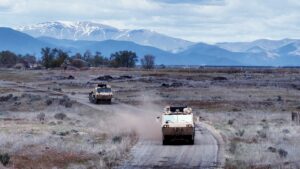
DA: One of the things soldiers are famous for is not wanting anything to do with “kit” that isn’t food, water or ammunition. How much resistance has there been to uncrewed systems in a combat environment? Has that changed radically, and how long does it take to familiarize new troops with their operation?
PA: Maybe I’ll tackle that backwards, if I may? So familiarization is, like, relatively straightforward. If you can play a video game, you can probably operate one of the robots, right? As you get into maintenance, it gets a little bit more problematic, a little bit more entailed. Field swaps, for example, is something that we look at pretty routinely. In industry the Field Service Representative is starting to take the route the dinosaurs took, which impinges directly on trust, since things will always need to be serviced. When I was a soldier, I thought about things within the span of my control: I could clean my weapon, keep my body clean, attack the enemy. But the things that drive a mission are inherently important, like the trust element we talked about earlier. Trust is paramount, and you get to trust through routine operations.
So I’m pretty excited about where things are heading in the US and, I think, globally. Rather than tasking people for a two-week demo, you’re saying ‘hey, this asset is going to sit with you in this formation and because of that, there’s a reason to invest time in understanding what it can do for you, because it’s going to go offset other pain points. I think one of the failure modes we got into was ‘like it or love it,’ you know. A battalion would show up to an exercise and get given kit, which then becomes an evaluation criteria, but they were focused on all the other risks and issues of preparation. As for the insertion technology, well, ‘we’ll do it in our free time. It’s interesting, but it’s not mission critical, because it’s not helping us solve the immediate task.’ I think that’s where the adoption or resistance decision lies. ‘Is this being levied on me, or am I saying, hey, I see how these tools actually impact our quality of life, therefore, I need to think about how to incorporate them into my plan early and often.’ That’s the little twist, the little tweak that goes a long way.
In the US and, I think, in the UK MoD and a number of other countries, transformation and regular contact are pushing the latter point of view – and, you know, I think that’s a great way to look at it. It’s not, ‘I built this thing now you take it and use it.’ It’s ‘hey, I want this thing to grow with me and help how I refine my doctrine, my organization, my training. And if it grows with me, it’s great.’ If it gets superseded or replaced, however, now you have to retool everything. There’s so many lessons to unlearn, and that’s where resistance comes in.
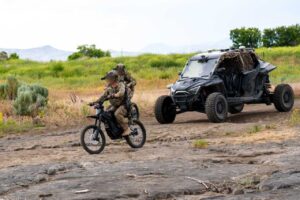
DA: You’ve seen some dramatic changes in the last few years. Where do you see this sector going in the future? Will the current pace of change be maintained – and what are the technology breakthroughs that will make that game-changing difference?
PA: Well- I’m betting on the pace being maintained in the market – and I think we’re well positioned to continue that over the next 3-5 years. I think the game-changing aspect will be the emergence of players who are very, very deep into specific features – they’re going to have great technical depth and will solve one part of the puzzle. Going back to the ‘point A to point B’ analogy, that’s part of the mission but not the whole mission, right? The game-changing aspect of that will be the ability to stitch together intentions from a general planning resource. ‘How am I forming my plan? How do I port that workflow and communicate down to units with their own intent and execution? How does that get translated to the platform?’ The question coming out of that is whether we are talking platform and payload or platform and mission equipment in order to streamline those decisions and own the entirety of the mission areas.
Use breaching as an example. I need to know where my obstacles are, so that’s the intelligence aspect to the mission. I have to then plan how I’m going to suppress, to obscure, to secure, reduce and breach. Each of those actions might have its own set of associated tools and decisions, so the game-changing part becomes how do I stitch that together? It’s no longer about hand walking different tools through friction points in several different pipelines, it’s more about creating a seamless execution playbook. ‘Go do this for me, robotic task force, because I will be preparing to exploit that breach.’ Delegating actions to robots creates mass and initiative inertia: anything that accelerates the timeline is where modern militaries pick up tempo.
DA: Pat – thank you for an insight into the world of autonomous ground combat – certainly a complex and multifaceted subject that I’m sure we will come back to before long.

Pat Acox – VP for Defense Growth at Forterra
All images courtesy Forterra