The ongoing conflict in Ukraine has heightened awareness of the importance of chemical, biological, radiological and nuclear (CBRN) preparedness. Ukraine has repeatedly accused Russia of violating the Chemical Weapons Convention, which bans the use of toxic agents in war. Over the entire period of Russia’s armed aggression against Ukraine, almost 12,000 cases of the use of toxic chemicals have been recorded, specifically chloropicrin, which was used as tear gas in WW1. The most commonly used gas grenades are the K-51 and RG-VO with CS and CN tear gases and special munitions dispensing irritants. As a result, the 704th CBRN Protection Regiment of the Armed Forces of Ukraine has recently been expanded to brigade level.
Earlier this year the UK and several European allies proved that Russian opposition leader Alexei Navalny was killed using Epibatidine, a potent neurotoxin developed from an Ecuadorian dart frog toxin, known for its ability to disrupt nerve cell function and cause paralysis.
A willingness to use chemical weapons has long been a feature of Russian aggression and, as a result, it was described as “the most acute nuclear, biological, and chemical (NBC) threat in the near-term” in the United States’ 2023 Strategy to Counter Weapons of Mass Destruction. In each of Russia’s five military districts, it has one NBC protection regiment assigned to peacetime rather than operational deployments resulting from its invasion of Ukraine.
In contrast are the NBC protection assets of European NATO members. The best equipped is Romania, with no less than 109 Ratmil RCH-84 NBC reconnaissance vehicles, followed by Germany and France, each of whose armies feature a single CBRN regiment equipped with 44 TPz-1 Fuchs and 25 VAB NRBCs respectively. Italy and Hungary each field 14 VBRs and 14 BTR-80M NBC vehicles while the United Kingdom has only eight TPz-1 Fuchs.
Since the end of the Cold War, Britain’s counter-CBRN forces have had a chequered history. The Joint Chemical, Biological, Radiological and Nuclear Regiment, stood up in 1999, was disbanded in 2011, leading to a significant reduction in the UK’s military CBRN capabilities. Responsibilities were then transferred to the RAF Regiment, leaving the Army with limited CBRN detection and decontamination capacity. 28 Engineer Regiment, Royal Engineers, was reformed on 1 April 2019 to focus on countering CBRN threats and environmental hazards including lethal nerve agents such as Sarin and VX, biological agents such as Anthrax and potentially hazardous radiological sources. It is equipped with the Fuchs 6×6 built by Thyssen-Henschel, in service since the Gulf War and upgraded several times to enhance their capabilities.

The Army is evaluating potential replacements for the Fuchs, with the Patria 6×6 being considered as a successor. They are expected to remain in service until at least 2029, pending the outcome of these evaluations and funds available for procurement.
The UK Strategic Defence Review in 2025 recommended the re-organisation of a UK Defence Research and Evaluation unit, whose dominant effort should be on chemical and biological defence. “This is the essential and urgent activity,” the report asserted.
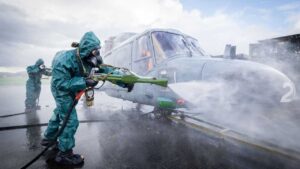
Although UK forces take part in low-key NATO CBRN exercises such as Toxic Trip 2025, which involved 450 participants from 14 NATO nations to train CBRN incident responses under realistic and challenging conditions in Norway, its counter-CBRN operations are limited.
NATO is continuing to support and facilitate national CBRN defence capabilities, including those of Allies and partners. Specific NATO assets, platforms and processes play a key role in supplementing national capability development efforts, including the NATO-wide network of Centres of Excellence (COEs), particularly the JCBRN Defence COE in the Czech Republic.
However, despite reported chemical attacks by Russia, there is no specific NATO or European counter-CBRN support for Ukraine, although in January 2025 the UK Armed Forces Minister, Luke Pollard, stated that the MoD “continues to assess and monitor the evolving threat picture in Ukraine, particularly when it comes to coordinating countermeasures of CBRN threats”.
Russia, along with China, has deliberately attacked the legitimacy and authority of the Organization for the Prohibition of Chemical Weapons (OPCW), along with its attribution and investigative mechanisms.
The Chinese Army has the largest number of NBC brigades in the world, with three in each of its five Theatre Commands. These regularly participate in chemical defence exercises, often with Russian NBC units. Although China is a party to the Chemical Weapons Convention (CWC) and claims to have destroyed its chemical weapon production facilities, allegations exist regarding non-compliance with treaty obligations, particularly in the development of dual-use technologies.
It has also been reported that China anticipates that biotechnology, including biological weapons, will be a dominant feature of the modern battlefield. China will not only defend itself against adversaries’ use of chemical or biological attacks with its NBC brigades, but could also use their biotechnology capabilities offensively.
In an effort to increase awareness of these CBRN threats, the US Joint Program Executive Office for CBRN Defense (JPEO-CBRND) maintains dozens of co-operative efforts with international allies to keep warfighters safe. Partnerships with allies enhance interoperability, encourage innovation and promote the exchange of valuable resources including expertise, capabilities and intelligence.
Last year, JPEO-CBRND hosted CBRN defence experts from across the US and UK for the Countering Weapons of Mass Destruction (CWMD) Science, Technology, and Acquisition Forum. This annual bilateral meeting is designed to foster collaboration between the two allies with a common interest in contributing to global security. When it comes to deterring CBRN threats and keeping their fighting forces protected, both the US and UK continue to co-operate.
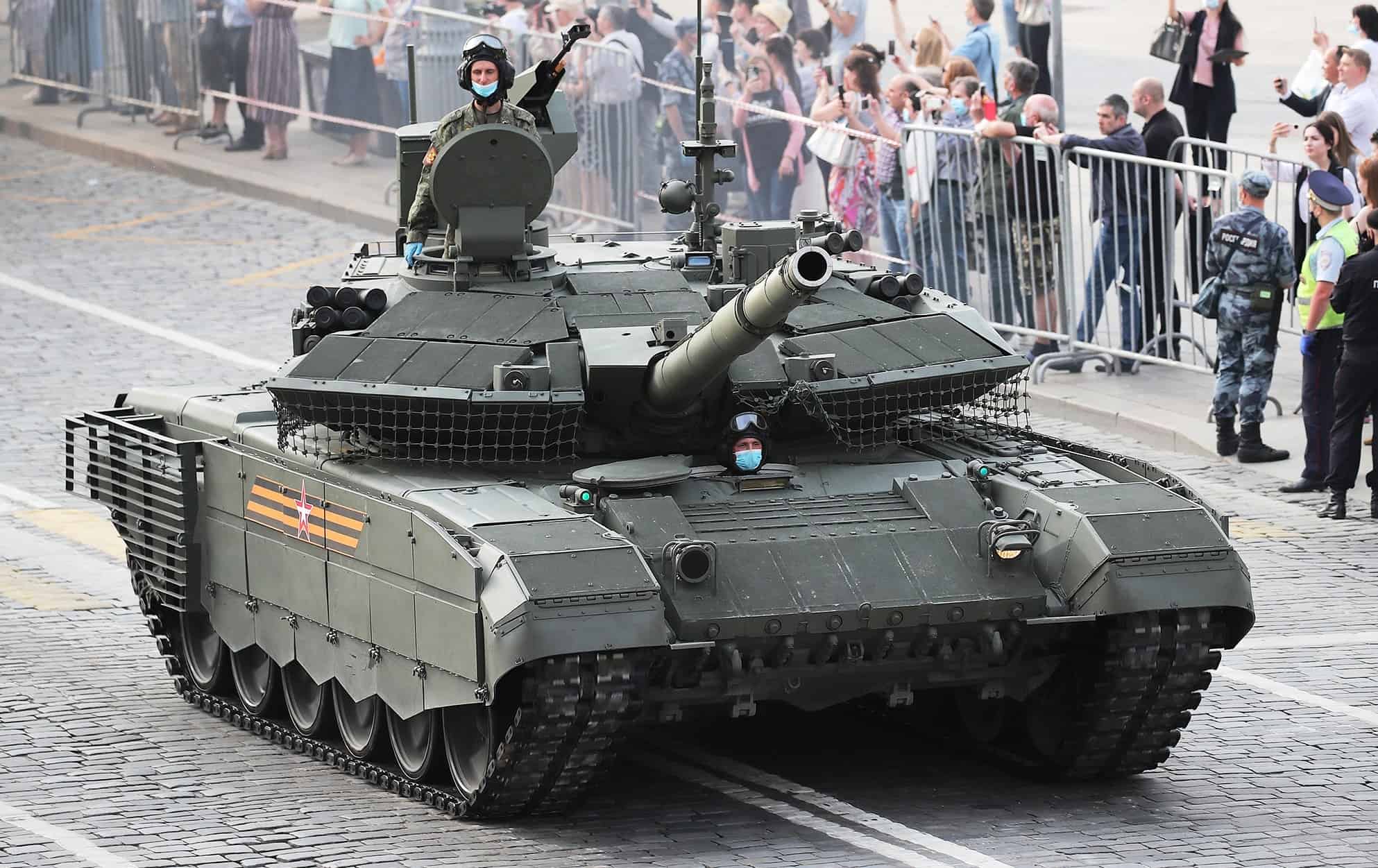
Headline image: A soldier from a PLA NBC brigade during a chemical defence training exercise. (Chinese social media)
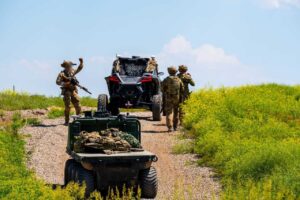
Body images: 1. Ukrainian troops training to counter Russian chemical attacks (Ukraine MoD). 2. NATO troops taking part in Exercise Toxic Trip 2025 (Norwegian MoD)
© David Oliver 2026