The concept of attacking land-based objects (or sea-based, for that matter) with kinetic energy weapons launched from space – dubbed by some ‘Rods from God’ – has long been a favourite recourse of science fiction writers. Scarcely surprising when you think some of those writers came from the defence industrial base prior to trying their hand at fiction – Jerry Pournelle (The Mote in God’s Eye and Lucifer’s Hammer, among others), who arguably was the modern father of the concept, was a Korean War veteran who headed Boeing’s Human Factors Laboratory.
But the reality is far from fictional. When the Outer Space Treaty in 1967 banned the deployment of nuclear, biological or chemical weapons in space, nations including the US, China and Russia began to revive studies into hypervelocity weapons capable of inflicting colossal damage on ground-based targets – but without the fallout or persistence associated with weapons of mass destruction. Various technical obstacles were overcome but the overriding barrier that nobody succeeded in hurdling was the sheer cost involved in hauling kinetic weapons (and their launch platforms) into orbit. Consider two factors: a typical ‘rod’ weighs in the region of nine tons; the typical cost of getting a one pound payload into space can exceed $10,000. Now do the maths…
Even so, after a lengthy hiatus, R&D began afresh in the US in 2018 with the Project Thor initiative. The result – nine ton tungsten-dense kinetic energy weapons capable of reaching speeds of Mach 10 prior to impact, unleashing energy (and destruction) that would rival that of a ground-penetrating nuclear weapon. Fin-stabilised, the size of a telegraph pole and launched from a satellite carrying a magazine of the projectiles, the ability to field a credible system capable of inflicting that level of destruction on an adversary becomes a powerful deterrent threat.
Prior to this, a 2002 RAND study and Air Force report titles Space Weapons, Earth Wars suggested that such a credible system could be fielded “in the next several decades”. Given the rhetoric emanating from both Trump administrations, the creation of a dedicated Space Force and the president’s oft-repeated assertion that nothing less than “complete domination” in every domain of warfare is acceptable – no matter the cost or consequences – and the belief that the US has the ability to field kinetic energy weapons in space – or is very close to having that ability – has gained huge numbers of supporters in the last few months. Is there tangible proof? Not yet. Is it likely? Well – the Space Force is managing over $800 million in classified programmes for which there is little public oversight. So that – plus the White House rhetoric over domination – give good cause to believe something along these lines may be imminent. An additional inspiration for US activity in the area is the news – not yet fully substantiated but with some visual evidence circulating on the Chinese internet – that the People’s Republic concluded an experiment dropping at least three kinetic penetrators from high altitude balloons in 2020 – an experiment deemed “satisfactory” by the authorities at the time.
Fiction is not always entirely made up….
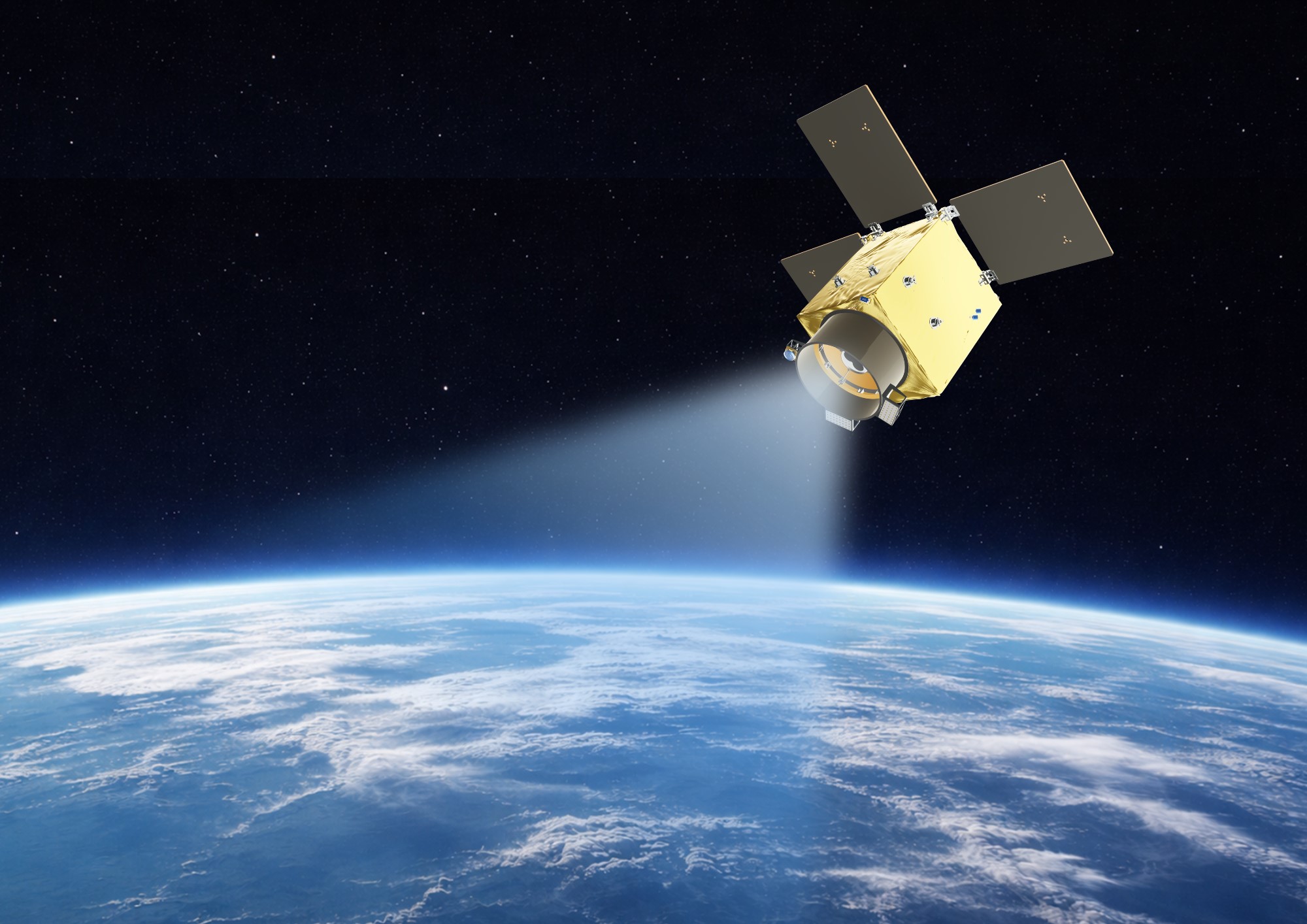
Headline image: a rendering of a possible space-based launcher for kinetic energy strikes. The ill-defined nature of the image perhaps reflects the uncertainty of the subject…[Wikimedia Commons]