Ever since the T-14 Armata was first seen in public a decade ago there has been an ongoing debate about whether the MBT will be upgraded with a more powerful main gun: specifically, the 152mm 2A83. Proponents of the upgrade claim that such a project is a ‘no-brainer,’ given the superior performance of the much larger gun. Reality, however, is somewhat different.
Developed in the 1980s and first tested in situ on the Objekt 195 prototype, which was then planned to go into production as Russia’s next MBT around 2010, the 2A83 is a further development of the 152mm 2A73, deployed for testing on the Objekt 477 ‘Mallet’ in the late 1970s. When the Soviet Union collapsed so, too, did the armaments industry and the 2A83 project was shelved, despite what were claimed to be “excellent” test results.
The focus then shifted to better 125mm tank guns offering the existing MBT fleet considerably enhanced performance. Contemporary media reports indicated an apparent plan to upgrade the T-90M with the 2A82 improved 125mm and further claimed that enhancing the T-14 Armata with the 2A83 would be “an easy upgrade.” In reality, the T-90M received a minor enhancement with the installation of the 2A46M5 weapon, while it has become apparent that the T-14 would require significant structural modification and systems modernization to accommodate the 152mm gun.
The attraction is based mainly on the premise that superior performance would be translated into overpowering combat superiority. Using APFSDS rounds at 2,000m, the 2A83 is reputed to penetrate 520mm of armour inclined at 60°, compared with the 450mm performance of the 2A82: a tangible but not necessarily tactically significant advantage. Against armour mounted vertically the delta increases to over 100mm – a not insignificant difference. Pragmatism, however, dictates the existing 125mm weapon is “good enough” for current operations, and does not demand long-winded assessment and modification of existing CONOPS.
The 2A83 is a capable weapon: it develops 25MJ of energy compared with the 2A82’s 15MJ and the APFSDS round has a muzzle velocity of 1,980m/s – the highest of any current round. Other claimed advantages stem from the potential effectiveness of cannon-launched ATGW – 1,400mm penetration, 20km range for the 152mm weapon, 950mm and 5km for the 2A82. The autoloaders are also part of the differential, with a 15rpm rate of fire claimed for the 2A83 and 12 for the 2A82.

But challenges trump aspirations. The scale of the issues standing in the way of an upgrade are legion. The 152mm weapon weighs in at 5,000kg, fully 2,300kg more than the 2A82; more of the 125mm rounds can be carried compared with the 152mm and the latter calibre will require significant investment in an ammunition supply chain, whereas the 2A82 can use the entire gamut of current 125mm rounds. Admittedly, the emergence of the ‘vacuum’ APFSDS round may provide the 2A83 with tactically relevant superiority: to date, however, verifiable information on this development is almost non-existent – though claims of armour penetration of 800-1,000mm at 2,000m are often seen in the media. Ultimately, however, it seems the preponderance of evidence is against seeing an up-gunned T-14 Armata any time soon. Indeed the T-14’s developer, Uralvagonzavod, is quoted on Russian social media as saying the best solution would be to design an entirely new MBT on the T-14 platform, rather than seeking to upgrade the existing tank. Not the smallest problems to be overcome would be how to fit a significantly larger turret onto the existing hull and how to reduce the cost, complexity and infrastructure constraints of the autoloader.
There is a final nail in the coffin for the hopes of those who look to an imminent upgrade. According to the most dependable statistics available, the Russian army has between 20 and 40 Armatas in service: period. And all those are apparently from the prototype batch. Manufacturing plans for 29 per year in 2023 and 2024 amounted to nothing: there is no evidence that a single tank was produced under either plan. Furthermore, not a single T-14 Armata has been seen in action in Ukraine over the last four years. Why that is so is the subject for an entirely separate column.
Nevertheless, given the advantages and attractions of a larger gun, the probability of a new Russian MBT mounting the 2A83 – albeit on a heavily modified platform – should be a case of “not if, but when.” Additional inspiration will undoubtedly stem from current German plans to field a 130mm gun-armed MBT in the mid-term and by the fact that other NATO member states will undoubtedly follow suit over time. However, given the alleged state of Russia’s economic woes and the apparently parlous state of the defence industry, it does seem, on balance, that the answer will be later, not sooner.
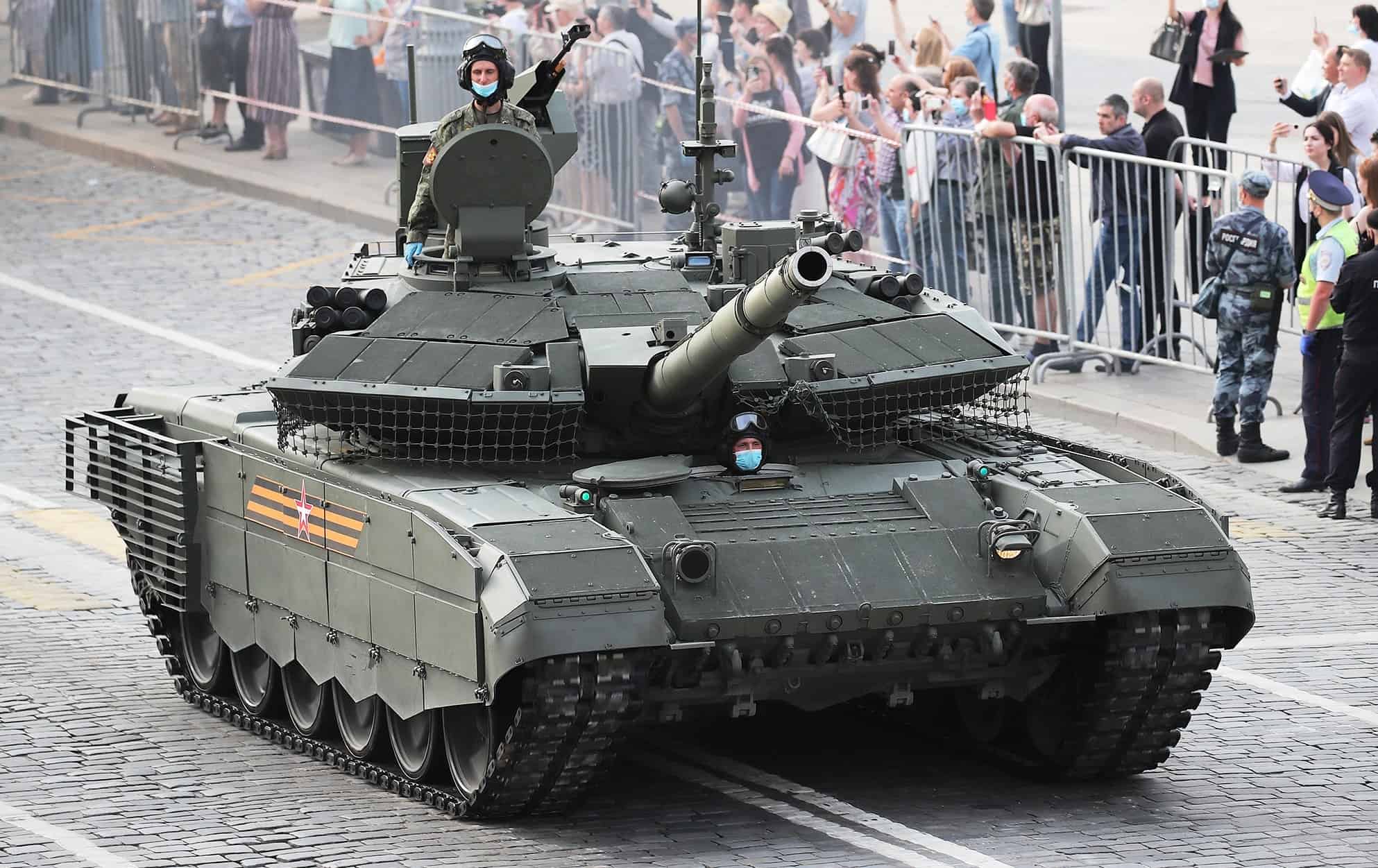
Headline image: a T-14 Armata in a public parade, via Russian internet. Body image: Russian army crews training on the T-14, via social media account of Vladimir Solovyov, Russian presenter and alleged propagandist.