To call the X-68A LongShot a missile-carrying missile is something of a misnomer, since it is a genuine UAS, launched from a manned aircraft and aimed at eliminating airborne threats using onboard munitions. “The objective of the LongShot program is to disrupt the paradigm of air combat operations by demonstrating an unmanned, air-launched vehicle capable of employing current air-to-air weapons, significantly increasing engagement range and mission effectiveness,” according to the project summary on the Defense Advanced Research Programs Agency’s (DARPA) website. Five years after the agency launched the programme in 2021, awarding Phase 1 design contracts to General Atomics Aeronautical Systems (GA-ASI), Lockheed Martin and Northrop Grumman, LongShot is expected to begin flight testing later this year.
Selected to continue into Phase 2 development in 2022, GA-ASI said at the time it expected to begin flight testing in 2024. Given the complexity of both the concept and the development programme, modest delays are scarcely surprising, especially when recognising the company is busily developing two other ground-breaking UAS at the same time – the XQ-67A Off-board Sensing Station and the YFQ-42A CCA. It is also important to recognise the successful completion of full-scale wind tunnel, parachute recovery and weapons release systems tests. Flight tests are expected to confirm flight worthiness, prove the safe and effective employment of the X-68A from an F-15 and demonstrate its ability to safely eject a captive sub-munition.
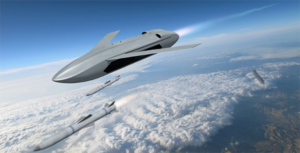
LongShot is to be platform agnostic – launchable from any compatible aircraft, including ‘support’ platforms carrying the UAS in pallets – though the imminent flight tests are to be conducted using an F-15. Further, although the design was for a UAS capable of controlled flight, DA understands the current status of the aircraft is autonomous. From the outset, DARPS stipulated it wanted an aircraft integrating “at least two existing air-to-air weapons,” thereby enabling multiple engagements.
LongShot has the potential to fundamentally change air combat operations. Flying ahead of follow-on forces and strike packages, the operations of the UAS will augment traditional fighter aircraft, dramatically increasing personnel safety while significantly extending the reach and mission effectiveness of the force package. It has to be remembered, however, that at this stage the programme is for a technology and concept demonstrator and the USAF has not been drawn out to state when – or if – such a system might be fielded.
Headline image: An artist’s rendering of LongShot in combat (DARPA/Colie Wertz)
Body image: A 2021 rendering of the LongShot UAS (DARPA)