By David Oliver
The Tejas developed by Hindustan Aeronautics Ltd (HAL – the name is Sanskrit for ‘brilliance’) is India’s first indigenous multirole fighter. Developed under the Indian Air Force’s (IAF) Light Combat Aircraft (LCA) programme and designed to replace the service’s recently-retired MiG-21 fleet, the Tejas represents a critical component of India’s ambition to reduce reliance on imported fighter platforms. The supersonic fighter, designed to fulfill the air superiority, interception and ground attack roles, features a tailless delta wing configuration, a digital fly-by-wire flight control system and is powered by a single General Electric F404 engine.
To date only 32 single-seat and eight two-seat Tejas Mk.1s have been delivered to the IAF, while 141 Mk.1As with improved avionics and radar and an in-flight refuelling capability are on order. However, the protracted development programme, that began more than 25 years ago, has faced criticism over delays, cost overruns and concerns about its performance have prevented any export sales.
The more advanced Tejas Mk.2, which has been under development by HAL in collaboration with India’s Defence Research and Development Organisation (DRDO) and the Aeronautical Development Agency (ADA) since 2009, is designed to deliver enhanced range and full-spectrum multirole capability. It will be equipped with an Indian-designed digital quadruplex fly-by-wire system to offer enhanced handling and stability during high-stress manoeuvres while ensuring redundancy for safety. The “4.5” generation fighter will be equipped with the indigenous Uttam AESA radar, developed by DRDO and the Electronics and Radar Development Establishment, which will reduce dependence on imported radar systems and is currently undergoing flight trials. It has a detection range of up to 200 km and an integrated Infrared Search and Track (IRST) system.
HAL and Bharat Electronics Limited (BEL) have developed wide-area multifunction cockpit displays for a glass cockpit interface, compatible with helmet-mounted displays.
HAL and DRDO have also jointly developed an open-architecture mission computer that integrates sensor fusion, weapon control and navigation functionalities, enabling seamless upgrades. DRDO’s Defence Avionics Research Establishment has designed an EW suite that provides radar warning, threat jamming and countermeasure deployment to enhance survivability in hostile environments. The DRDO is also testing an indigenous ejection seat for the Tejas Mk.2 as a possible alternative for the Martin-Baker 16LG zero-zero ejection seat.
Capable of carrying a heavier weapons payload, the Mk.2 will deploy the Astra all weather beyond visual range air-to-air missile (BVRAAM) developed by DRDO, precision-guided bombs and stand-off weapons. It will be powered by the General Electric F414-GE-INS6 afterburning turbofan engine which has a maximum thrust output of 98kN with improved specific fuel consumption over the F404 powering both Mark 1 and Mark 1A variants.
Originally intended to power production models of the Tejas, the GTX-35VS Kaveri is a 90kN thrust afterburning turbofan project under development by India’s Gas Turbine Research Establishment (GTRE). Despite years of testing and development, the Kaveri engine has never been declared fully airworthy, having faced persistent issues with weight, thrust output and endurance. However, following over a decade of delays, HAL and GE finally signed an MoU in June 2023 to co-produce the F414 engine in India. In June 2025, HAL stated that technical negotiations for transfer of technologies for the engines were concluded and that th commercial negotiations were expected to be concluded within three months. These have not yet been confirmed. With its first flight targeted for June 2026, and introduction into service expected by 2028, this seems unlikely bearing in mind the type’s protracted development.
It is possible that the Tejas Mk.2 could also be retrofiitted in the future with engines and radars being developed for India’s Advanced Medium Combat Aircraft (AMCA) fifth-generation stealth fighter, the first flight of which is planned for early 2029. India is currently looking to partner with a foreign engine manufacturer: General Electric, Rolls-Royce and Safran have all been in talks to create a joint venture for the new engine. India is hoping that a “Made in India” engine will mitigate the delays associated with relying on foreign aircraft engine manufacturers, which India has faced with both the GE F404 and F414 engines for the LCA Tejas variants.
India aspires to introduce 90 percent indigenous content in the Tejas Mk.2, but successfully integrating the complex and diverse advanced “Made in India” technologies within a tight timeframe may well prove to be a serious challenge. Any delays will be a serious problem for the IAF, especially in view of its losses during Operation ‘Sindor’ in May 2025 when, according to the Royal United Service Institute, Pakistan Air Force J-10CEs shot down IAF fighters at a distance of approximately 200km using Chinese PL-15E air-to-air missiles.
It is telling that IAF Tejas squadrons took no part in air combat operations during the border conflict: the troubled indigenous multirole fighter has yet to earn its fighting spurs.
© David Oliver 2026
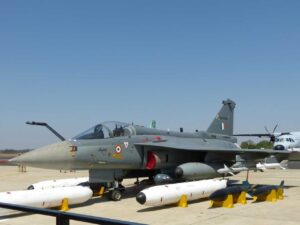
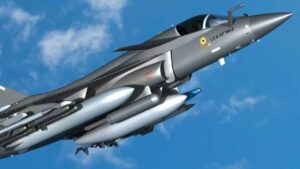
Headline image: Testing the Indian-designed ejection seat for Tejas Mk.2 (DRDO). Body image 1: A Tejas Mk.1 showing the breadth of its air-to-air and air-to-ground weaponry (David Oliver). Body image 2: The Tejas Mk.2 has yet to make its first flight (IMoD)