Another thought-provoking piece from David Oliver, looking at recent episodes in the nation’s quest for greater military presence on the global stage. A particularly timely submission – Defence Alternatives begins a series of articles examining aspects of “the China question” in the next several weeks.
2025 saw an unprecedented expansion of the People’s Republic of China’s military capability, with new warships commissioned and prototype manned and unmanned aircraft unveiled almost monthly.
China flew the world’s largest drone mothership, the jet-powered AVIC Jiutian capable of launching more than a hundred attack in swarm mode, for the first time in December. At the same time LOONG UAV started testing its M9 kamikaze strike drone, which closely resembles the Russian Geran and the Iranian Shahed.
Yet another maiden flight was announced in December, this one for the China Aerospace Science and Technology Corporation (CASC) CH-7. Li Jianhua of CASC said the “highly successful” maiden flight validated the CH-7’s basic performance, autonomous taxiing, take-off and landing, attitude control and trajectory tracking. The stealthy CH-7 is designed for high-altitude flight to conduct ISR, maritime surveillance and data relay missions, as well as providing target designation for long-range strike weapons.
Among the manned aircraft, the Shanxi Y-30 airlifter, similar to the Airbus A400M, made its first flight in December. The Y-30 is designed to enhance China’s ability to conduct rapid force projection and sustainment operations for China’s island outposts. For the same role China is also developing a large four-jet wings-in-ground-effect (WIG) aircraft, based on the Soviet-era ‘Caspian Sea Monster’ Ekranoplans.
The second prototype Chengdu J-36 Sky Dragon stealth fighter made its first flight in 2025. The sixth-generation tri-jet tailless diamond-double-delta winged aircraft is being developed by Chengdu Aircraft Corporation (CAC) to fulfill multiple missions, including air superiority, strike, interception and C2 for UAS such as collaborative combat aircraft (CCA).
As part of China’s relentless drive to dominate the future battlespace, its other sixth-generation stealth fighter, the tailless delta-wing Shenyang J-50 prototype, had been undergoing a series of test flights last year. If and when it enters production, it could be a serious rival to the projected GCAP, FCAS and US NGAD air combat systems.
The People’s Liberation Army Navy’s latest aircraft carrier, the first-of-class Type 003 Fujian, was commissioned on 5 November 2025 at the Sanya Naval Port on Hainan Island, in a ceremony attended by Chinese President Xi Jinping. The 300m-long vessel, with an estimated displacement of 80,000 tonnes, is the first Chinese aircraft carrier to be equipped with an Electromagnetic Aircraft Launch System (EMALS). The vessel’s island features panels that will house the AESA radar and images indicated two close-in weapons systems, two missile-based point defence systems and a centrally located section showing what could be directed energy or possibly acoustic weapon systems.
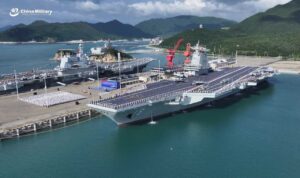
Earlier, the carrier conducted a series of take offs and arrested landings of the PLAN’s Catapult Take-Off But Assisted Recovery (CATOBAR)-capable Shenyang J-15T fighter, the latest Shenyang J-35 stealth fighter, and the twin turboprop Xian KJ-600 Nezha long-range AEW&C aircraft.
The latest type to enter PLAN service, the carrier-based Nezha is powered by a pair of WJ-6 turboprops and fitted with a dorsal radome housing an AESA radar. With a range of 1,250km, the KJ-600 will extend a carrier group’s early detection of air and surface threats, improving its ability to co-ordinate long-range strikes in the disputed South China Sea.
Weeks later, China’s first new-generation Type 076 amphibious assault ship, the Sichuan, began sea trials. The 252m-long, 45,000t vessel is one of the largest amphibious assault ships in the world. It features typical stern access for LCU- or LCAC-type transports or amphibious vehicles and the flight deck uses two side-mounted elevators for moving aircraft to the hangar below. Other newly-launched vessels include the Type 054AG frigates for the PLAN, and Type 054-based offshore patrol vessels for the Coast Guard. In addition, another even larger aircraft carrier is believed to be under construction.
To date, the PLAN has lacked carrier-capable training aircraft but this may change with the first flight of a naval two-seat twin-engine advanced trainer in October. The Hongdu-designed aircraft, equipped with reinforced landing gear and an arrestor hook, appeared similar to the US Boeing T-7A with its twin tail and side-mounted air intakes. This will be another factor in ensuring China’s carrier task force’s future blue-water dominance.
However, with the rapid introduction of all these new platforms, the PLA is facing serious problems in recruitment of skilled engineers and advanced training of naval officers and combat pilots in particular. Despite carrying out frequent large-scale exercises on land, sea and air, the PLA lacks any significant recent combat experience.
The Main Focus of China’s National Defense and Military Development 2026-2030 review was published in December. Under the heading of ‘Speeding up the development of advanced combat capabilities’, its stated aims are to “intensify strategic and tactical planning, take solid steps to make our military training more oriented toward actual combat, strengthen the systematic integration of combat capabilities and create new models for building up and applying our fighting capacity, in order to enhance ability to maintain the initiative and shape posture through targeted operations.”
Nevertheless, the 100th anniversary of the founding of the People’s Liberation Army in October 1947 is fast approaching: what could be a more rewarding event to celebrate China’s leadership than a successful invasion of Taiwan in 2027?
© David Oliver 2026.
Headline image: China flew the world’s largest drone mothership, the jet-powered Jiutian, in December 2025 (AVIC). Body image: Fujian, the PLAN’s latest aircraft carrier, commissioned in November 2025 with a J-15T fighter, a J-35 stealth fighter and a KJ-600 AEW&C aircraft on board. (Chinamil.com).