The ‘Arms and the Mahon’ column – launching today (5 January 2026) lies at the heart of Defence Alternative’s ethos: to promote critical thinking, to share alternative perspectives and to cause readers to walk away thinking about issues more profoundly. Although the other DA channels focus on news-related and news-derived articles, this channel is where the original thinking and (perhaps) the more controversial material will be found.
It is a great pleasure to host the first such piece, contributed by veteran writer, author, editor, photographer and journalist David Oliver: the subject matter is particularly topical…
FCAS Meltdown
by David Oliver
The European Future Combat Air System/Système de Combat Aérien du Futur (FCAS/SCAF) was launched over eight years ago but is now stalled by industrial rivalries.
The FCAS programme, led by Dassault Aviation, Airbus and Indra Sistemas, aims to create a sixth-generation fighter jet and associated UAS. In October 2025 Spain approved a €350 million loan to Indra and its Airbus joint venture for the FCAS and New Generation Weapons System (NGWS) development, in order to show support for the tri-national programme with France and Germany. Belgium became an observer of FCAS in June 2023.
However, the three partners planned to resume talks last November to discuss the next phase of the project, including a flying demonstrator and armed drone packages, amid disagreements over leadership and industrial roles, particularly involving Dassault Aviation.
At the time Airbus CEO, Guillaume Faury, said “Our partner has been very open that they are not happy with the workshare that was agreed for the programme and they are asking for something different, which is not what was agreed: if they are not happy with what was decided and they do not agree to continue in this setup, they are free to decide to move out of FCAS.”
In an 11 November interview France’s newly-appointed Defence Minister, Catherine Vautrin, added further pressure, noting that “the subject with Germany is about the carrier. There is currently no capacity in Germany to manufacture an aircraft. You will grant me that one does not build an aircraft overnight. It requires a certain amount of know-how.” She added that France and Germany must still agree on how to “see the uses of this carrier and to see how we can move forward” and further described Dassault as “the reference” in fighter aircraft while acknowledging Airbus as a European leader. The Minister then highlighted the unresolved question of the next-generation fighter’s engine, describing it as an issue of sovereignty and “a sophisticated and complex question.”
During a parliamentary hearing last November 2025, French Air and Space Force General Frédéric Parisot Mandon stated that the engine will be the toughest technological challenge for FCAS. He noted that Safran and MTU Aero Engines have to combine technologies that neither company currently fields and cautioned that the engine’s development timeline will also have direct consequences for the rest of the programme.
France, Germany and Spain planned to meet on 11 December to resolve disputes over the €100 billion programme. France wants decisive control over the next-generation fighter (NGF), while Airbus seeks an equal say on workshare and governance before building a demonstrator for delivery by 2040.
On 8 December Germany’s powerful IG Metall union warned it will stop cooperating on the FCAS programme if Dassault Aviation remains involved, escalating tensions ahead of planned ministerial talks.
The French employers’ organization for the metalworking industry, UIMM, whose president Éric Trappier is also CEO of Dassault Aviation, expressed “its astonishment” after IG Metall’s call, which “seeks to oust a French technological flagship of military aviation” from the FCAS programme. “French industry companies cannot accept such a position aimed at excluding France’s industrial interests from this strategic project,” nor from “any other European strategic industrial project,” the statement read.
Meanwhile, German Air Force chief Lt. Gen. Holger Neumann said Berlin may explore alternatives for a future combat aircraft if the programme faces continued delays and political issues. Priority is a networked force with a combat cloud and unmanned systems, with the next crewed NGF potentially chosen via multiple options. However, following talks between President Macron and Chancellor Merz, Berlin drafted a “decision roadmap” aiming for industrial partners to sign a cooperation agreement on core programme principles by mid-December, while air force chiefs review national requirements.
Boris Pistorius of Germany, Catherine Vautrin of France and Spain’s Margarita Robles met in Berlin on 11 December to discuss the project’s fate. However, sources said no decision was taken at the talks, which took place just weeks before a year-end deadline put forward by Chancellor Merz for a decision on the next steps. France has not publicly put a firm deadline on agreeing the next phase of the project, which involves stepping up spending to build a flying demonstrator. Merz and Macron were expected to seek a resolution when they met at the meeting of European Union leaders on 17-19 December.
A senior German lawmaker suggested that a focus on data network capabilities, known as the ‘Combat Cloud’ and on unmanned systems could salvage the project, with each country focusing on its own core fighter jet under a common umbrella.
The future of FCAS remains uncertain, however, with ongoing discussions about its viability and potential alternatives being considered by both Germany and Spain. Meanwhile, Airbus is said to be partnering with Saab on its Loyal Wingman, while Germany could be looking at joining rival project, the Global Combat Air Programme (GCAP) being developed by the UK, Italy and Japan.
At the end of day, is it realistic to expect two rival, strikingly similar European future fighter projects to succeed. Watch this space!
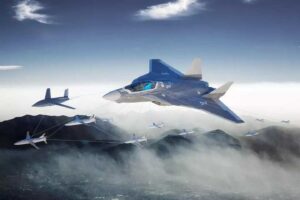
Headline image: Dassault concept for the FCAS NGF. Body image: Airbus concept for the FCAS NGF and drone swarm. [Dassault Aviation and Airbus respectively]
© David Oliver 2025